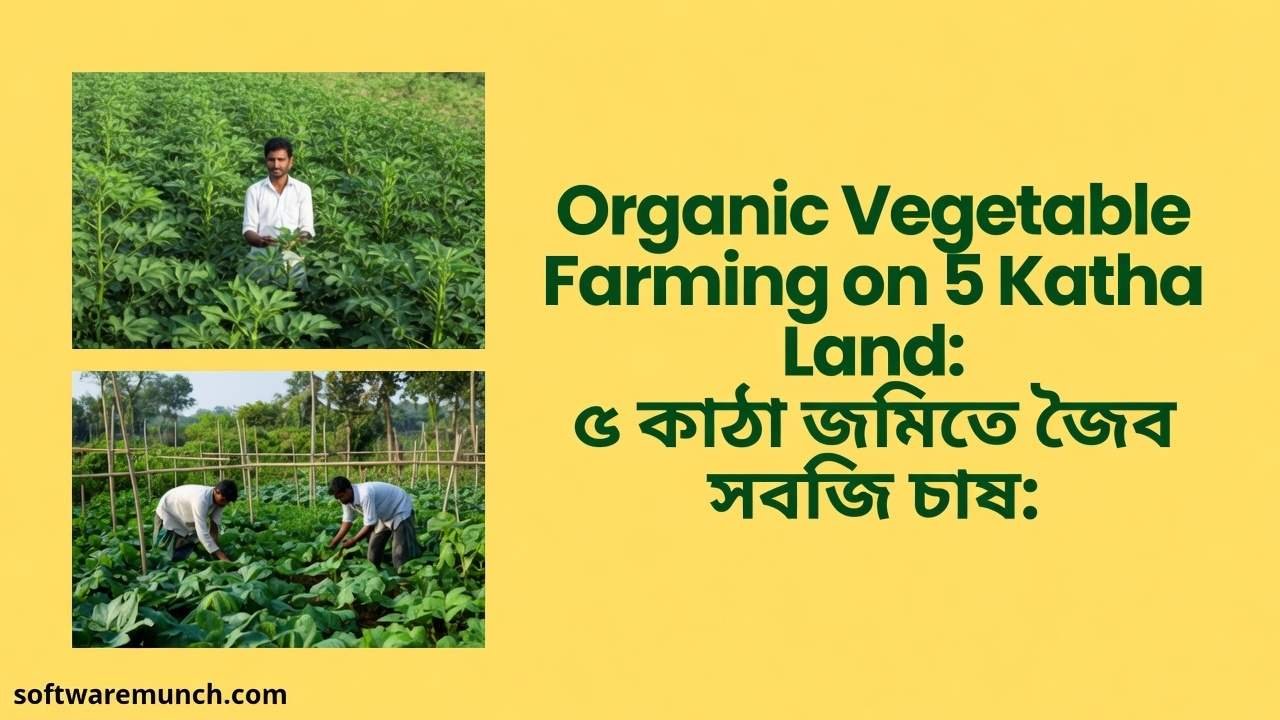
Starting With What You Have
In many villages of Assam and West Bengal, people often feel that farming is only profitable for those who own large amounts of land. A young man with five katha land may look at his small plot and think there is no future in agriculture. Many leave their villages in search of jobs because they believe farming cannot support a family anymore.
But if we look closely, we can find many farmers who started with very little land and gradually built successful farming businesses. Organic vegetable farming is one opportunity that does not require huge landholdings. A farmer can begin with a small plot, gain experience, build market connections, and later expand by leasing neighbouring land.
In places like Silchar, Karimganj, Hailakandi, Cooch Behar, Malda, Murshidabad and countless other towns, people buy vegetables every single day. Hotels, roadside food stalls, hostels, restaurants and vegetable dealers are always looking for fresh produce. This constant demand creates an opportunity for rural families willing to work hard and learn.
As we often say in Bengali, “Chhoto kore shuru korun, aste aste boro korun.” Start small and grow gradually.
Choosing Vegetables That Sell Throughout the Year
A common mistake made by new farmers is focusing on only one crop. They hear that tomato prices are high and plant only tomatoes. Then hundreds of other farmers do the same thing and the market price falls.
A smarter approach is to grow several vegetables together. A five-katha plot can easily accommodate brinjal, chilli, spinach, coriander, okra, tomatoes and seasonal gourds. When one crop faces a price drop, another crop may compensate.
The climate of Assam and West Bengal is suitable for vegetable cultivation during most of the year. Winter vegetables such as cabbage, cauliflower and tomatoes perform very well, while summer crops like bottle gourd, cucumber, bitter gourd and okra can provide income during warmer months.
The objective should not be to become rich in one season. The objective should be to create a steady source of income throughout the year.
Understanding the Initial Investment
Many people assume farming requires several lakhs of rupees. In reality, a small organic vegetable farm can often be started with a modest investment.
The main expenses usually include land preparation, quality seeds or seedlings, organic manure, irrigation pipes, fencing materials and a few basic farming tools. Most rural households already possess some of the necessary equipment, which reduces the initial cost.
Bamboo fencing is still commonly used in villages and can provide affordable protection from cattle and goats. Simple water pipes and a small pump may be enough during the beginning stages.
A farmer who plans carefully and avoids unnecessary expenses can start on a relatively small budget.
How to Use Government Support and Loans
One of the biggest advantages available to farmers today is government support. Unfortunately, many villagers believe that government schemes are difficult to access or are meant only for large farmers. In reality, many small farmers successfully use these schemes every year.
The first step should be visiting the Agriculture Department office at the block level. Agriculture officers are usually aware of current schemes, subsidies and training programmes. They can guide farmers regarding available benefits and explain how applications should be submitted.
Before visiting, it is useful to carry Aadhaar Card, voter card, bank account details, passport-size photographs and land documents if available. Even if the land belongs to a family member, discussing the farming plan with agriculture officials can still be helpful.
The next important step is applying for a Kisan Credit Card. This scheme helps farmers obtain credit from banks at reasonable interest rates. Instead of borrowing from local moneylenders, farmers can access funds specifically meant for agriculture. The loan amount can be used for purchasing seeds, organic manure, irrigation materials and fencing.
Farmers should also consider getting their soil tested through the Soil Health Card programme. Many people spend money on fertilizers without knowing what their soil actually needs. A soil test provides valuable information and often saves money in the long run.
Attending training programmes organized by Krishi Vigyan Kendras can be extremely beneficial. Many of these programmes are free and cover topics such as vegetable cultivation, pest management, irrigation and organic farming techniques. A few days of training can prevent mistakes that might otherwise cost thousands of rupees.
Government nurseries are another valuable resource. Instead of buying unknown seedlings from roadside sellers, farmers can often obtain healthy planting material from government-supported sources. Better seedlings usually mean stronger plants and higher yields.
Farmers should also ask agriculture officers about irrigation subsidies. Water is one of the most important requirements for vegetable farming, and government support can reduce the cost of irrigation systems.
Keeping all documents organized in a simple file makes future applications much easier. Whenever a new scheme becomes available, farmers who already have their paperwork ready are often able to apply quickly.
Most importantly, any loan received should be used carefully. The money should go into productive assets such as seeds, irrigation facilities and organic inputs. The first profits should be reinvested into the farm rather than spent elsewhere. This gradual approach allows the business to grow steadily without creating unnecessary financial pressure.
Learning Before Expanding
Modern farming requires more than physical labour. Successful farmers are always learning.
Many valuable lessons can be obtained from experienced farmers living nearby. Visiting successful vegetable growers and observing their methods often provides practical knowledge that books cannot offer.
Krishi Vigyan Kendras and agriculture offices regularly organize demonstrations and workshops. These programmes help farmers understand crop selection, disease management and seasonal planning.
Today, even a simple smartphone can become a powerful learning tool. Bengali and Assamese agricultural videos explain farming techniques in a language that local farmers can easily understand. A farmer who continues learning usually performs much better than someone who relies only on old methods.
Making Organic Farming Affordable
Organic farming does not necessarily mean spending large amounts of money. In fact, one reason many farmers choose organic methods is because they reduce dependence on expensive chemical inputs.
Cow dung available in villages can be converted into high-quality compost. Crop residues that are often discarded can become valuable organic matter for improving soil fertility.
Many farmers are now producing vermicompost, which not only improves soil health but can also be sold to other farmers for additional income.
Neem-based preparations are another useful tool. Instead of purchasing costly pesticides, farmers can prepare simple organic solutions using locally available materials. These methods reduce expenses while helping maintain soil quality.
Over time, healthy soil becomes one of the most valuable assets on the farm.
Expanding Beyond Five Katha
The first year should be viewed as a learning phase. Success should not be measured only by profit. Knowledge, experience and market connections are equally important.
Once a farmer begins producing vegetables successfully, opportunities for expansion often appear naturally. In many villages, there are landowners who are unable to cultivate their fields because they have moved away, taken jobs elsewhere or become too old to farm.
Such land can often be leased at reasonable rates. A farmer who has already proven that vegetables can be grown profitably on five katha will find it easier to take additional land and expand.
Many successful farmers started with small plots and gradually increased their cultivated area over several years. Patience and consistency are often more important than starting with a large farm.
Finding Buyers and Building a Market
Producing vegetables is only one part of the business. Selling them effectively is equally important.
Weekly village markets provide a good starting point. Selling directly to consumers allows farmers to receive immediate payment and understand local demand.
As production increases, vegetable dealers become important partners. Dealers purchase larger quantities and provide access to wider markets. Building a good relationship with reliable dealers can ensure regular sales throughout the year.
Nearby towns such as Silchar, Karimganj, Hailakandi, Malda and Berhampore receive vegetables from surrounding villages every day. Farmers who consistently supply fresh produce often develop a stable customer base.
Some growers eventually supply restaurants, hotels and hostels directly. These businesses require fresh vegetables regularly and often prefer dependable local suppliers.
Farmer Producer Organizations can also help small farmers access larger markets. By working together, farmers can purchase inputs at lower prices and sell produce more efficiently.
Thinking Like a Business Owner
One habit separates successful farmers from unsuccessful ones. Successful farmers treat agriculture as a business.
Every expense should be recorded. Every sale should be noted. Farmers should know exactly how much money was invested and how much was earned from each crop.
Without records, it becomes difficult to identify which crops are profitable and which are not. Simple notebooks are often enough to maintain these records.
A farmer who studies market demand, learns continuously and manages expenses carefully has a much greater chance of success.
Five katha may appear small to many people. Yet for a determined farmer, it can become the first step toward a larger agricultural enterprise. With proper planning, government support, continuous learning and consistent effort, organic vegetable farming can provide a reliable source of income and help build a brighter future for the entire family.