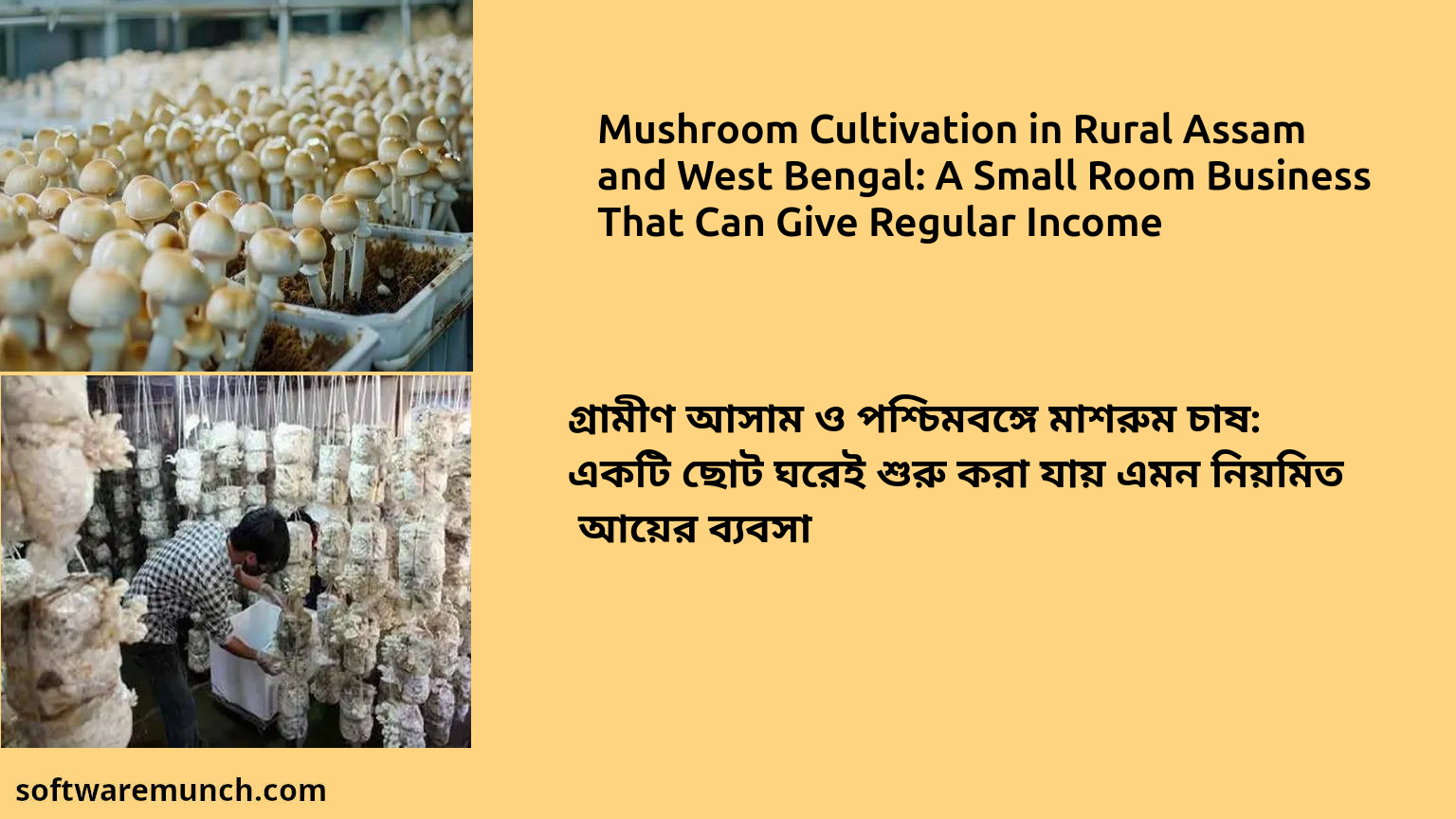
In many villages of Assam and West Bengal, people think farming means only rice, vegetables or fish. Very few people consider mushrooms as a serious source of income. But in recent years, mushroom cultivation has slowly become one of the most practical small businesses for rural families, especially for those who do not have much land.
A farmer does not need big fields for mushrooms. Even a small shed, a spare room, or a corner of the house can become a place of income. In places like Silchar, Barak Valley, North Bengal districts like Cooch Behar, Jalpaiguri, Malda and Murshidabad, many young people and women have started mushroom farming as a side business.
It is simple, low investment, and the demand in local markets is slowly increasing. Hotels, vegetable sellers, and health-conscious families now buy mushrooms regularly. What was once considered an “urban food” is now entering rural kitchens.
As many elders say in simple words, “jomi kom holeo chesta kom hobe na” — even if land is small, effort should not be small.
Understanding Mushroom Farming in Simple Language
Mushroom is not a plant like tomato or brinjal. It grows from organic materials like straw. The most common type grown in villages is oyster mushroom, because it is easier to produce and does not require expensive equipment.
Another type is milky mushroom, which grows well in warm climates like Assam and West Bengal. Both types can be grown inside a controlled space, away from direct sunlight.
The biggest advantage is that mushrooms grow fast. In about 30 to 45 days, a farmer can get harvest. This makes it suitable for people who need quick returns instead of waiting for months.
How a Small Space Becomes a Mushroom Farm
In many villages, unused rooms, mud houses, bamboo sheds or even small cement rooms can be converted into mushroom units. The space does not need to be big, but it should be clean and slightly humid.
Farmers usually hang straw bags inside the room where mushrooms grow. Water is sprayed lightly to maintain moisture. There is no need for heavy machines or expensive infrastructure in the beginning.
In rural Assam, bamboo structures are often used because they are cheap and easily available. In West Bengal villages too, old storage rooms or cattle sheds are commonly converted.
Investment and Basic Setup
A beginner can start mushroom cultivation with a small amount of money, often between ₹10,000 to ₹40,000 depending on scale.
The main requirements include paddy straw, mushroom spawn (which is like seed), plastic bags, a water sprayer, and a small space. Most of these materials are easily available in local markets.
Paddy straw is especially important because it is widely available in both Assam and West Bengal after rice harvesting. Instead of burning straw, farmers can use it for mushroom production, which also helps reduce waste.
The spawn should be purchased from reliable government or certified suppliers, because quality spawn directly affects production.
Step-by-Step Government Support and How to Use It
Many farmers do not know that mushroom farming is also supported under various government agriculture schemes. With proper guidance, a small farmer can reduce costs significantly.
The first step is visiting the local Agriculture Department office or Krishi Vigyan Kendra. Officers there can explain whether any mushroom training, subsidy, or demonstration programme is currently running in the district.
After that, a farmer should ask about training programmes. In many districts, free training is given where farmers are taught how to prepare mushroom beds, maintain hygiene, and manage temperature. These trainings are very useful because mushroom farming depends more on technique than land.
The next step is applying for a Kisan Credit Card. Even though mushroom farming is small-scale, the KCC can help cover initial expenses like buying spawn, straw, and setting up the room. Banks like rural banks and public sector banks usually support such applications if basic documents are available.
A farmer should also enquire about subsidies for horticulture and allied activities. In many states, mushroom units are supported under horticulture missions. Sometimes farmers get assistance for setting up small mushroom sheds or buying equipment.
Soil testing is not required for mushrooms, but guidance on environment control is often provided by agriculture departments. Farmers should also keep documents ready, because whenever a scheme becomes active, quick application improves chances of approval.
The important point is simple: government help is not automatic. It comes when the farmer visits offices, asks questions, and follows the process step by step.
Daily Work and Care in Mushroom Farming
Mushroom farming does not require heavy labour, but it requires regular attention. The room must be kept clean, and moisture should be maintained by spraying water lightly.
Too much water can damage the crop, and too little water can stop growth. Balance is important. Farmers usually check the bags daily and remove any contaminated portions to prevent spread of disease.
Temperature control is also important. In hot summers, proper ventilation helps. In colder months, mushroom growth is often better.
Unlike traditional farming, mushrooms do not depend on soil quality or weather conditions outside. This makes it suitable for year-round production in rural areas.
Harvesting and Income Pattern
After about one month, small mushroom pins begin to appear. Within a few days, they grow into full mushrooms ready for harvest.
One batch can give multiple harvest cycles. After one round is completed, farmers can start a new cycle using fresh straw and spawn.
Income depends on scale and market, but even a small unit can give regular weekly income once production becomes continuous. This is why many rural families treat mushroom farming as a steady side income rather than a one-time crop.
Selling Mushrooms in Local Markets
Selling mushrooms is often easier than expected. In many towns of Assam and West Bengal, demand is increasing, especially in hotels, restaurants, and urban vegetable markets.
In local haats and weekly markets, farmers can directly sell fresh mushrooms. Vegetable dealers also purchase in bulk if quality is good.
In towns like Silchar, Guwahati, Siliguri, Malda and nearby areas, mushrooms are slowly becoming part of regular vegetable trade. Some farmers even supply directly to hotels, which prefer fresh and locally produced mushrooms.
Proper packaging in small boxes or simple leaf wrapping helps improve selling price and appearance.
Learning Before Expanding
Mushroom farming is a skill-based activity. It is better to start small and learn properly before expanding. Many farmers make mistakes in the beginning due to lack of hygiene or improper moisture control.
Visiting Krishi Vigyan Kendras, attending training programmes, and observing successful farmers can save a lot of loss in early stages. YouTube videos in Bengali and Assamese also help beginners understand basic methods in simple language.
A farmer who learns carefully in the first two or three cycles often becomes successful in later production.
Expanding the Business Slowly
Once a farmer becomes confident, mushroom units can be expanded. Instead of one room, two or three rooms can be used. Some farmers even convert small sheds into continuous production units where harvesting happens every week.
At this stage, mushrooms can also be processed into dried products, pickles, or powder, which increases shelf life and market value.
Women self-help groups in many villages have successfully turned mushroom farming into a group business, sharing production and selling collectively in larger markets.
Thinking Beyond Farming
Mushroom cultivation is not only farming; it is also a small rural enterprise. It teaches discipline, cleanliness, and market understanding. It also gives quick returns compared to many traditional crops.
For a rural family with limited land, it can become a strong additional income source. For unemployed youth, it can become a starting point for self-employment.
With proper guidance, government support, and consistent effort, even a small room in a village house can become a source of regular income. Mushroom farming shows that in today’s time, success in agriculture is not only about land, but also about knowledge, planning, and willingness to try something new.