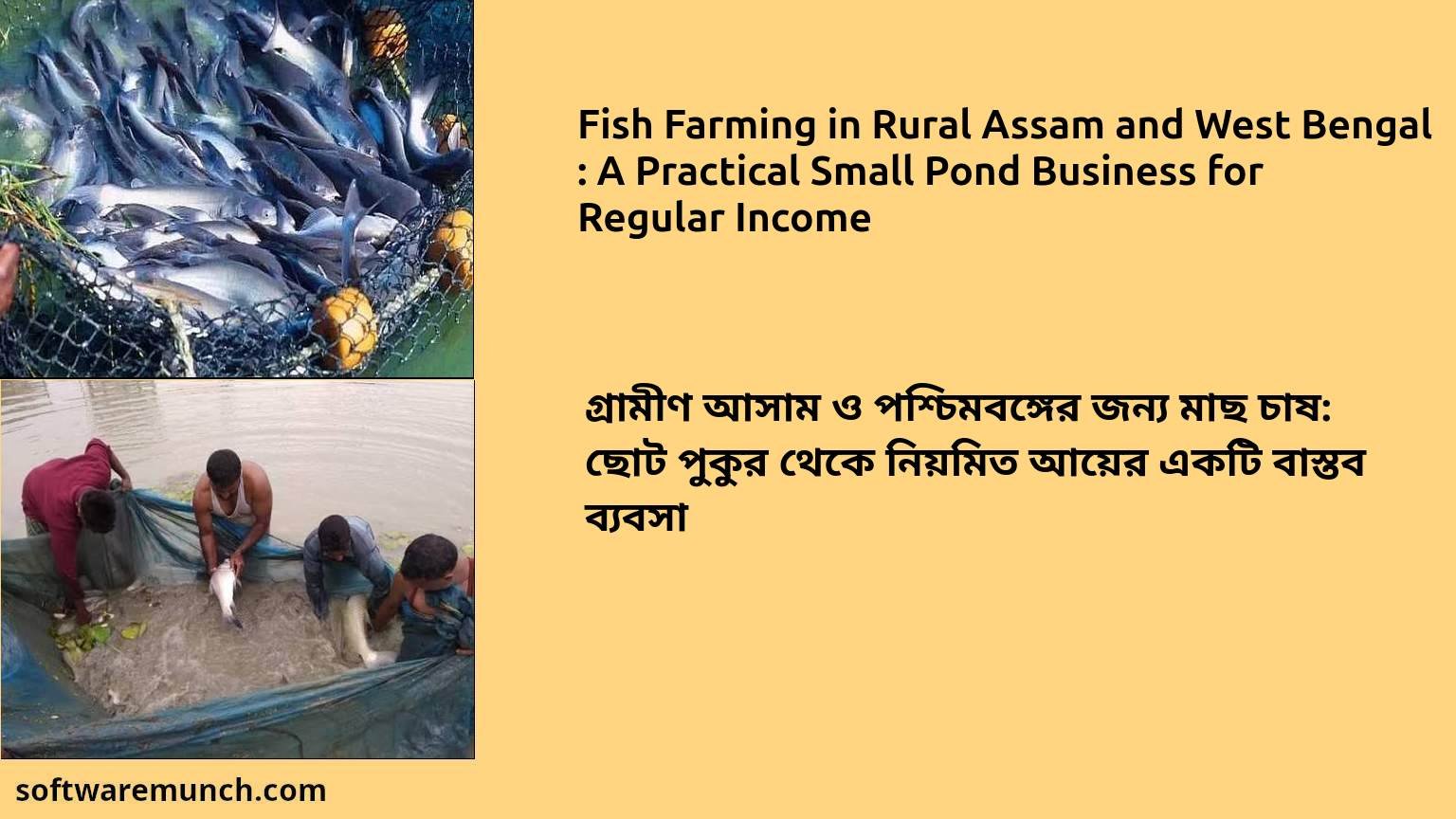
In rural Assam and West Bengal, fish is not just food, it is part of daily life. Almost every household consumes fish regularly, which creates a constant demand in local markets throughout the year. Because of this steady demand, fish farming has become one of the most practical rural businesses, even for families who own only a small pond.
Many people think fish farming requires large ponds, heavy investment, and advanced technology. In reality, even a 5 to 10 katha pond can become a steady source of income if managed properly. Across places like the Barak Valley in Assam and districts like Malda, Murshidabad, Nadia, Cooch Behar, and Jalpaiguri in West Bengal, small-scale fish farming is already helping rural families earn a stable livelihood.
Starting with a Small Pond
Fish farming does not always require large land or big investment. A small pond near the house is enough to begin. If a family does not own a pond, in many villages ponds can be leased from neighbours or landowners at a reasonable cost.
In the beginning, the goal is not to earn maximum profit but to learn the process. Proper pond cleaning, water management, and correct stocking of fish are more important than scale. Even a small pond can give good results if these basics are followed.
In many villages, unused or neglected ponds are common. These can be cleaned and revived at low cost, making them suitable for fish farming.
Choosing the Right Fish for Farming
The climate of Assam and West Bengal is highly suitable for freshwater fish farming. Commonly farmed species include Rohu, Catla, Mrigal, Pangasius, and Tilapia.
A very effective method is mixed fish farming. Instead of growing only one type of fish, multiple species are stocked together. This reduces risk and improves productivity. For example, Catla feeds at the upper layer of water, Rohu in the middle layer, and Mrigal at the bottom. This natural division allows multiple species to grow in the same pond without competing heavily for food.
Tilapia is also popular because it grows fast and has steady demand in local markets. It is often preferred by small farmers for quick returns.
Initial Investment and Preparation
Fish farming can start with moderate investment. The main preparation includes cleaning the pond, applying lime to balance water quality, and arranging fish feed and fingerlings (baby fish).
Fingerlings should be purchased from trusted hatcheries or government fisheries centers to ensure good quality. Stocking density should be kept moderate in the beginning to allow proper growth.
Fish feed is an important part of the cost. Farmers commonly use rice bran, mustard oil cake, and commercial fish feed depending on availability and budget. Proper feeding at regular intervals ensures faster growth and better market size.
Step-by-Step Use of Government Support
Government support can significantly reduce the cost and risk of fish farming, but many farmers are not fully aware of how to access it. Following a step-by-step approach makes the process easier.
The first step is visiting the local Fisheries Department office at the block level. Officers there can provide information about ongoing schemes, subsidies, and training programs available for fish farmers. In many districts, demonstration projects and free training sessions are conducted for beginners.
The second step is attending training programs organized by Krishi Vigyan Kendras or fisheries departments. These trainings cover pond preparation, fish stocking techniques, feed management, and disease control. Even a short training session can help avoid costly mistakes.
The third step is applying for a Kisan Credit Card (KCC). This loan facility is very useful for fish farming as it helps cover expenses such as fingerlings, feed, pond renovation, and maintenance. Public sector banks and rural banks generally provide such loans under agricultural schemes.
The fourth step is checking for fisheries-related subsidies. In many states, government schemes support pond renovation, fish seed stocking, and infrastructure development. These subsidies may cover a part of the cost, reducing the financial burden on farmers.
The fifth step is keeping all necessary documents ready. Aadhaar card, bank account details, land or pond ownership documents, and photographs are usually required for applications. Having these ready in advance makes the process faster and smoother.
Government support is most effective when farmers actively visit offices, ask questions, and follow the application process properly.
Daily Care and Management
Fish farming requires regular attention but not very heavy physical labor. The pond should be monitored daily to ensure water quality is stable, fish are feeding properly, and there are no signs of disease.
During rainy seasons, water conditions can change quickly, so extra care is needed. Some farmers use lime or other natural treatments to maintain water balance.
Proper management reduces fish mortality and improves growth rate, which directly increases profit.
Selling Fish in Local Markets
Fish selling is usually not difficult in Assam and West Bengal due to strong local demand. Fish can be sold in village markets, weekly haats, and nearby town markets.
Local fish traders often purchase directly from ponds, which makes selling easier for farmers. If the quality is good, restaurants and hotels may also become regular buyers.
Cities and towns such as Silchar, Guwahati, Malda, Siliguri, and Berhampore have continuous demand for fresh fish. Farmers who can maintain consistent supply often build long-term buyer relationships.
Growing Gradually Over Time
Fish farming should be seen as a gradual process. A farmer usually starts with a small pond, learns the basics, and then expands slowly by leasing additional ponds or improving existing ones.
Many successful fish farmers today started with very small ponds and limited investment. Over time, through experience and reinvestment of profits, they expanded into larger operations.
With proper planning, patience, and regular care, fish farming can become a stable and long-term income source for rural families in Assam and West Bengal. It is not just an agricultural activity but a practical rural business that can grow step by step.