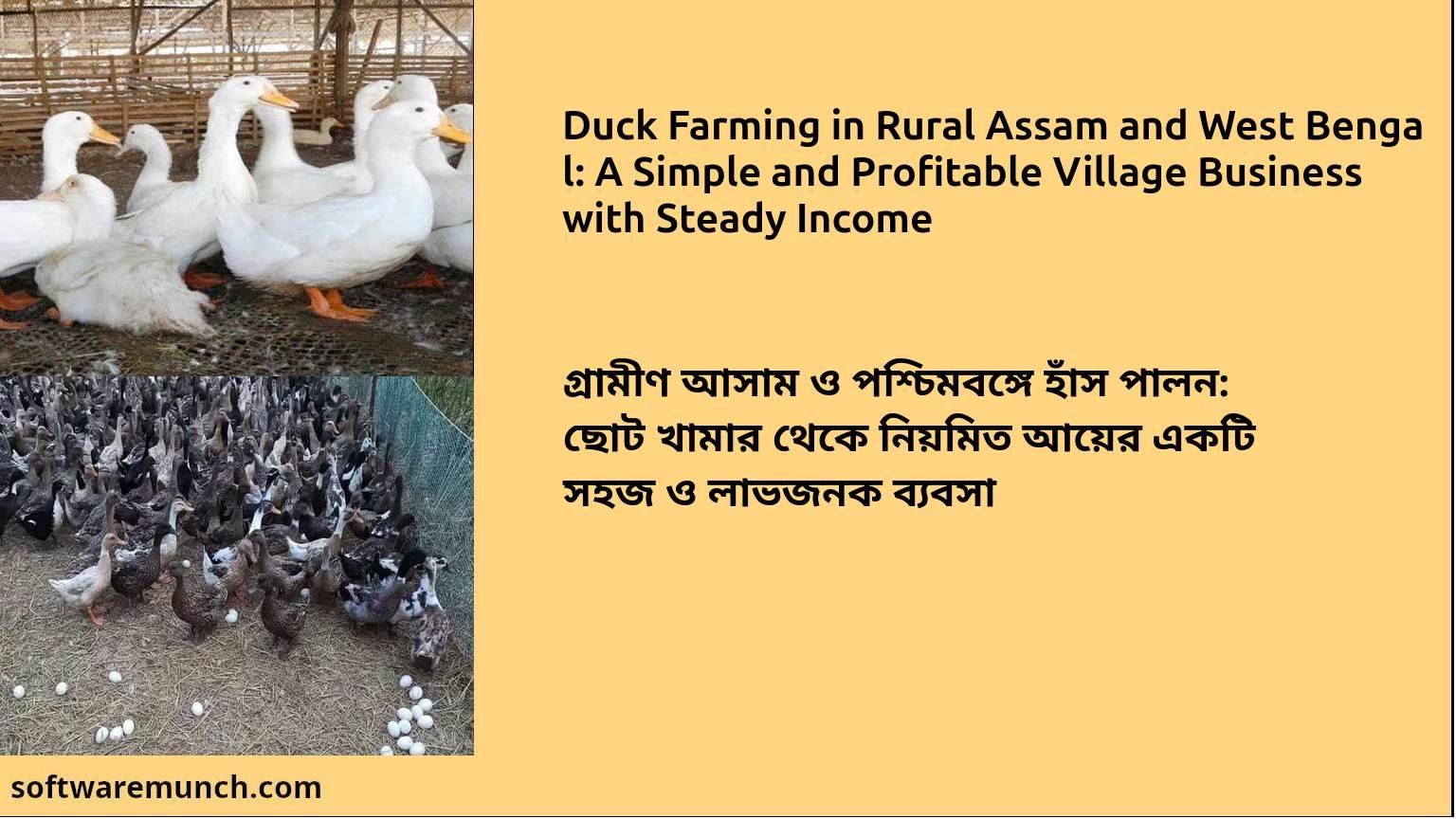
In the villages of Assam and West Bengal, especially in wetland areas, duck farming has always been a familiar part of rural life. Many households keep a few ducks for eggs and meat, but only a few people treat it as a proper business. In reality, duck farming can become a strong source of income even for small farmers who do not have large land or expensive resources.
Unlike many other types of farming, ducks are naturally suited for village environments where ponds, canals, rice fields, and wetlands are common. That is why areas like Barak Valley in Assam and districts like North 24 Parganas, Nadia, Cooch Behar, and Murshidabad in West Bengal have strong potential for duck-based livelihoods.
As villagers often say in simple words, “haans palle taka ase” — there is money in duck rearing if it is done properly.
A Real Example from Karimganj
In Karimganj district of Assam, there is a small farmer named Rahim Ali . He started duck farming with almost nothing. He had a small pond behind his house and a tiny piece of land that was not enough for regular agriculture.
At first, Rahim kept only 20 local ducks. He used to let them roam freely during the day near the pond and bring them back in the evening. He did not have any formal training or knowledge. He simply learned from his neighbors.
He recalls that in the beginning, people in the village used to say, “ei kaaj e labh nai” — there is no profit in this work. But he continued slowly.
After some months, he realized that duck eggs were selling every week in the local market. Demand was constant. Unlike seasonal crops, ducks produced eggs regularly.
He then decided to expand. He took a small loan through a Kisan Credit Card and increased his duck count to 100. He also improved the shelter and started feeding them properly instead of only depending on natural food.
Today, Rahim supplies duck eggs to nearby markets in Karimganj town and even sells duck meat during festive seasons. His words are simple: “shuru te chhoto chilo, ekhon kaj ta cholche” — it started small, but now it is running steadily.
His journey shows that duck farming does not require big capital, only patience and consistent care.
Why Duck Farming Fits Rural Assam and Bengal
Duck farming works very well in regions where water is easily available. Ducks naturally enjoy wet environments, and they can also help in controlling insects in ponds and rice fields.
In Assam and West Bengal, many villages already have ponds or waterlogged areas. This reduces the cost of setting up infrastructure. Ducks can feed on insects, snails, and leftover grains, which reduces feed cost compared to other livestock.
Another advantage is that ducks are hardy animals. They are generally more resistant to diseases compared to chickens if basic hygiene is maintained.
Choosing the Right Ducks
In rural farming, two main types of ducks are commonly used. Local breeds are strong and can survive in natural conditions, while improved breeds produce more eggs and grow faster.
Many farmers prefer a mix of both. Local ducks are easy to manage, while improved breeds increase production.
Egg production is one of the main income sources in duck farming. Ducks can lay eggs consistently for a long period, which creates regular weekly income.
Starting Small with Low Investment
Duck farming does not require large investment at the beginning. A farmer can start with 20 to 50 ducks and gradually expand.
Basic requirements include a small shelter, access to water, and simple feeding arrangements. In many villages, bamboo sheds are used because they are cheap and easy to build.
Ponds or nearby water bodies are a big advantage, but even without a large pond, ducks can be raised in open areas with water containers.
Feed usually includes rice bran, broken rice, kitchen waste, and locally available grains. This makes duck farming more affordable compared to many other livestock businesses.
Daily Life in Duck Farming
Duck farming is not very complicated, but it requires daily attention. Ducks need to be let out in the morning and brought back in the evening if they are not fully enclosed.
Clean water should always be available. Feeding should be regular, especially for egg-laying ducks.
One important part is protecting ducks from predators like dogs, foxes, or wild animals. A simple fencing system can help reduce losses.
Farmers often say, “roz dekha na korle loss hoy” — if you do not check daily, you may suffer loss.
Step-by-Step Government Support for Duck Farming
Government support can play an important role in duck farming, especially for beginners who do not have enough capital. However, many farmers are not aware of how to access these benefits.
The first step is visiting the block-level Animal Husbandry or Fisheries and Livestock office. Officers there provide information about ongoing schemes for poultry and duck farming. They also guide farmers on training programs and subsidies.
The second step is attending training programs. Many Krishi Vigyan Kendras and government departments conduct free or low-cost training sessions. These trainings help farmers understand duck care, disease prevention, feeding methods, and shelter management.
The third step is applying for a Kisan Credit Card or livestock loan. This helps farmers buy ducklings, build shelters, and purchase feed. Many rural banks support such loans under agricultural schemes.
The fourth step is checking for subsidies. In many cases, the government provides partial financial support for poultry and duck units, especially for small farmers and self-help groups.
The fifth step is keeping documents ready. Aadhaar card, bank account details, and basic land or pond details are usually required. Having these ready makes the process faster.
Government support works best when farmers actively visit offices and follow up regularly instead of waiting at home.
Selling Eggs and Meat in Local Markets
Duck farming becomes profitable only when selling is managed properly. In rural Assam and West Bengal, there is strong demand for duck eggs and meat.
Eggs can be sold in weekly village markets, local shops, and nearby towns. Many families prefer duck eggs for their taste and nutrition.
Duck meat is in demand during festivals and special occasions. Traders often buy ducks directly from farmers in bulk.
Farmers like Rahim from Karimganj often sell eggs daily in small quantities and sell ducks in larger batches during festive seasons. This combination creates both daily and seasonal income.
Common Mistakes to Avoid
Many beginners make mistakes such as overfeeding, poor shelter management, or ignoring hygiene. Some also start with too many ducks without understanding market demand.
It is always better to start small, learn properly, and then expand slowly.
Another mistake is not protecting ducks from predators. Even a small loss can affect income significantly.
Growing Step by Step
Duck farming is not a quick-rich business. It grows slowly but steadily. A farmer starts with a small number of ducks, learns the system, and then increases production gradually.
Over time, duck farming can become a stable income source, especially when combined with pond farming or rice cultivation.
Many successful farmers in Assam and West Bengal today started with very small backyard duck units. With patience and proper care, they turned it into a regular livelihood.
As Rahim from Karimganj says in simple words, “kaaj chhoto holeo income steady hole bhalo lage” — even if the work is small, steady income brings peace.